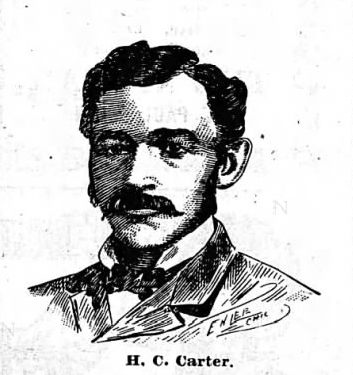
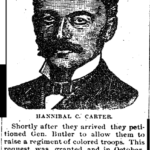
Hannibal C. Carter (Warren County)
Secretary of State: 1873
State House: 1872-1873, 1876-1877
Born: February 1835 in New Albany, IN
Died: June 1, 1904 in Chicago, IL
See below for published descriptions of his early life and military service, and see this biography written by Kelly Navies, a descendant of his brother Edward, at the Smithsonian’s National Museum of African American History and Culture.
Carter was the son of George Washington “Wash” Carter (1801-1878), a free man of color living in New Albany, IN, and recorded on the 1830, 1840, and 1850 census there. A successful businessman, he was active on the Underground Railroad. According to census records over the years, Carter and his wife, Ann, had more than ten children, two of whom were born while the Carters were in Canada.
Hannibal C. Carter was first listed on the census by name in 1850 with his family in New Albany. After fighting for the United States in Louisiana during the Civil War, Carter moved to Vicksburg and became prominent in Mississippi politics. He was the driving force behind the 1873 civil rights law. The 1880 census of Vicksburg lists him as Hamilton C. Carter, “retired merchant.”
Though Edward Carter remained in Mississippi and stayed active in politics in Tunica County, Hannibal Carter moved to the midwest about 1881 for more safety and opportunity. He was last documented by the census in 1900, living with his sister, Emma, and her husband in Chicago.
“Ham Carter” was a common nickname used for him in newspapers. I don’t know if it was derogatory or a nickname he used for himself. His middle name is given as Caesar in one newspaper article, but a descendant who was named for him had the middle name Cleveland.
“Hannibal C. Carter was born at New Albany, Ind., February 1835, but his early childhood was spent at Toronto, Canada. He received a common school education at New Albany, and then when old enough learned the barber trade and was also a tobacconist.”
(The St. Paul Appeal, July 25, 1891)
“During the Reconstruction period, many of the officers of the Native Guard became leaders in the Republican Party. Hannibal assisted in the reconstruction of Tennessee in 1867. In 1868 he was elected as representative from the Eighth Congressional District. In that same year he moved to Mississippi and became involved in the politics of reconstruction there, also. He represented Warren County, Mississippi, in the State Legislature three times and was twice appointed Secretary of State. He was active in getting the Gray-Carter Civil Rights Bill passed in June of 1873.”
(Pamela R. Peters, The Underground Railroad in Floyd County, Indiana, 2001; click here to read more extensive excerpts about the Carter family in Floyd County)
Links:
Family History Project Leads Siblings to New Albany – Kelly and Richard Navies, descendants of the Carter family, talk about their family history
George Washington Carter Had Significant Impact on New Albany
George Washington Carter’s memorial on Find A Grave
Suggested Reading: The Underground Railroad in Floyd County, Indiana, by Pamela R. Peters (2017 ebook).










This page was last updated on May 12, 2026.