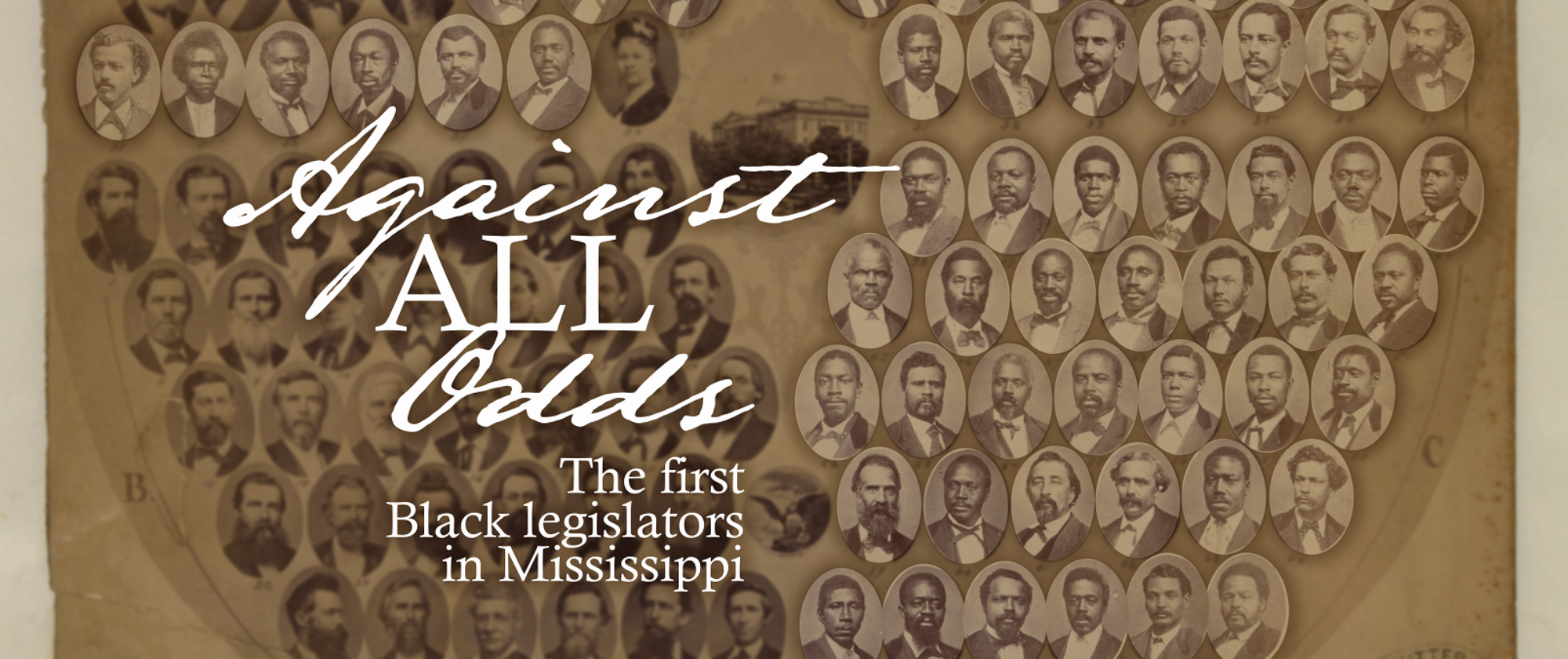

Tributes to Senator Charles Sumner, who died March 11, 1874. From the 1874 Mississippi House Journal.
REPORT OF SPECIAL COMMITTEE.
MR. SPEAKER – I am instructed by your committee, appointed to present a series of resolutions expressive of the sense of this House on account of the afflicting event which has so recently befallen the country in the death of the Hon. Charles Sumner, to present the following resolutions, and recommend their adoption.
Respectfully,
J. D. CESSOR,
Chairman.
WHEREAS, By the death of the Hon. Charles Sumner the world has lost one of its brightest and best intellects, our country one of her greatest statesmen, liberty one of her ablest champions, and human rights the most faithful, untiring and efficient advocate; therefore,
Resolved, That this House, submissively and solemnly acknowledging the dispensation of Divine Providence in removing, by death, the Hon. Charles Sumner, recognize the mournful event with emotions of the profoundest sorrow, and sincerely feel that no language can adequately express our exalted estimation of his character, or our affection, respect and veneration for his memory.
Resolved, That it is no unbecoming exaggeration to say, that in the death of Hon. Charles Sumner the Nation has lost one of the most refined and accomplished scholars that has adorned its forensic, legislative or literary annals.
Resolved, Of his gifts and attainments as a lawyer, orator, statesman, publicist, philanthropist, citizen and man, not only the legislative halls of his own Commonwealth, but the national forum have been witnesses, while his varied learning, scholarly efforts on many varying occasions, have been heard and read by admiring and enthusiastic multitudes, whose remembrance of them is still fresh, full and green.
Resolved, That we do no injustice to the living or the dead in saying, that for the peculiar abilities desirable for diplomat, publicist and tribune – for combination of accurate memory, logical acumen, vivid imagination, profound learning in the international law, exuberance of literary knowledge, and command of language, united with masterly skill, he stood transcendent of all the giants of his time.
Resolved, That this House do now adjourn for the day, out of respect for the memory of the great departed, and that these resolutions be spread upon the Journal.
——
Mr. Spelman said:
MR. SPEAKER – It is with a heart filled with deep sorrow that I rise in my place to say a few words upon the resolutions just reported by your committee. Throughout this broad land, where the telegraph has flashed the sad intelligence of the death of Senator Sumner, there are hearts bowed down with grief, at the loss of that great and good man, the untiring and devoted friend of the oppressed of every nation and of every clime.
Senator Sumner early espoused the cause of the poor slave, and until his freedom was secured, until he was endowed with the ballot to maintain his freedom, he stood firm and unflinching in the advocacy of his claim. The noble attitude, which for many years, he sustained on the question of human rights will not soon be forgotten by those who, to-day, are reaping the benefits derived from his actions. Slaves, then freemen, then statesmen – all owing their elevation, step, by step, to the unswerving zeal of Senator Sumner.
When the proposition was presented in the Senate of the United States, to remove the disabilities imposed by the Fourteenth Amendment to the Constitution, Senator Sumner, proposed that the disabilities should be removed, which still debarred the colored people from the enjoyment of public privileges, exercised by other people, and which debased them in the eyes of the world. In accordance therewith, he arose in his place and moved, as an amendment, his famous Civil Rights bill – completing a two-fold measure of justice to mankind.
When Horace Greeley became a candidate for the highest office in the gift of the people, Senator Sumner supported his co-laborer in the anti-slavery struggle, and estranged himself from many of his former associates, who sharply criticized his course. The vote of the colored people for the first time was to be cast for a President, and while they appreciated the life-long services of Horace Greeley, the unbounded friendship of Senator Sumner, they felt in their hearts that, as the Republican party had brought them out of the dark labyrinth of oppression into the glad sunlight of freedom and citizenship, they should maintain their fealty to that party.
When the three Amendments had been adopted and became a part of the Constitution of the country, which forever settled the question of equal rights, Senator Sumner, in his great magnanimity of heart, moved a resolution in the Senate to erase from the battle-flags of Federal regiments the names of the battles in which they were engaged during the late war. His sole object was to bring about a better feeling between the two sections, and that all evidences of strife should be buried in oblivion. In a moment of passion the Legislature of Massachusetts censured the great American. The people of that grand Commonwealth, in their might and majesty, arose and demanded, through resolutions and petitions, the rescinding of those resolutions. The demand was complied with, and a few days before his death a special messenger from the Legislature of Massachusetts presented to Charles Sumner an enrolled copy of the rescinded resolutions. How cheering this act of his constituents, in rectifying a grievous wrong, must have been in his last moments. And what a happy feeling of reconciliation he must have realized toward those who had wronged him, when he folded his arms and passed to the world beyond the stars. His eloquent voice is hushed, his great heart has ceased to beat, his continuous guidance has been withdrawn from us. May we honor his memory, and show our gratitude for his life, by taking heed to his counsels and walking in the way on which the light of his wisdom shines.
——-
Mr. Harris, of Washington, said:
True, Mr. Speaker, a hundred thousand lives were sacrificed in the war for liberty, but none of these fought more bravely or efficiently for the freedom I enjoy, than Charles Sumner.
Not the eagle, whose eye, when soaring amid the clouds, flashes back the burning beams of the noon-day sun, loved freedom more than did this great man.
The immortal three hundred who defended the pass of Thermopylae, gave their lives a willing sacrifice that their country-men might be free, but not more self-sacrificing were they than Charles Sumner’s whole life proved him to be, in behalf of my race.
When he espoused the cause of the colored race, no man dared predict their freedom. The position they occupy to-day was hidden in the unfathomable mysteries of God. The race was in the midst of a wilderness, surrounded by dangers and encompassed with barriers to their enfranchisement which seemed impregnable. Charles Sumner was not deterred by the difficulties of the situation; he became their Moses from choice, and impelled by his inate sense of justice; and the position I now occupy this day proves that he was a leader and prophet from God. Talk of building a monument to his memory! Mr. Speaker, he reared a monument to himself, whose foundations are laid in freedom and cemented with the love of a grateful race, and whose shaft reaches to the celestial city.
He sleeps, Mr. Speaker; he can never die while a colored man breathes the sweet and fragrant air of freedom.
———-
Mr. Jones, of Issaquena, said:
MR. SPEAKER – America mourns the loss of one of her greatest statesmen. Charles Sumner is no more. For thirty years he has filled a prominent place and performed an important part in the affairs of this nation. He was a thorough believer in the declaration that “all men were created free and equal;” this principal became the mainspring of all his actions. While others might deem the sentiment a choice one for public declamations, Charles Sumner founded all his speeches and all his actions upon this theory, and worked constantly to make its truth apparent and recognized by the downfall of slavery. I trace his history for thirty years. It runs parallel with this sentiment with geometrical accuracy, until the teaching has brought us to what we are to-day.
I thank God, with heartfelt reverence, that Charles Sumner lived, and that He endowed him with brain, and courage, and energy, and inspired him with the will to use these to the end that all men might enjoy the destiny for which they were created – perfect freedom and equality before the law everywhere under the sun. With bowed head and sad heart I approve the resolutions offered here to-day. Among all who have lived and passed away, the name of none will be more blessed than that of Charles Sumner. He was the leader and greatest among those of whom it is well said:
“How sleep the brave, who sink to rest
By all their country’s wishes blest?
When Spring, with dewey fingers cold,
Returns to deck their hallowed mold,
She there shall dress a sweeter sod
Than Fancy’s feet have ever trod.
By fair hands the knell is rung,
By forms unseen their dirge is sung;
There Honor comes, a pilgrim grey,
To bless the turf that wraps their clay;
And Freedom shall awhile repair
To dwell a weeping hermit there.”
———
Mr. Gayles, of Bolivar, said:
MR. SPEAKER – On Wednesday, March 11th, at three o’clock in the afternoon, one of the brightest lights which ever illuminated the human race, was eclipsed in death. Charles Sumner walks among the children of men no more. He was one of the very few who have lived and labored, upon whom earthly dignities reflected no honor. Born in 1811, in the historic city of Boston, he graduated at Harvard University in 1830. All his long and pure life he was the champion of freedom. His great love for polite literature, his high appreciation for beauty of thought, chaste pictures and magnificent scenery, made him a natural poet, and inclined him to avoid the noisy and clamorous arena of politics. His greater love for his fellow-men, and his supreme horror for wrong and wrong-doers, compelled him to take a part, and made him an early and uncompromising Abolitionist, and from first to last he was the leader of all those who demanded equal rights and exact justice for the men and women of any race. His denunciations of the wrongs of slavery caused him to be struck down in his seat by the murderous hand of a slaveholder, as long ago as 1856, and he suffered from this blow until his sufferings were exchanged for the bliss of Heaven.
A volume would not contain all the commendable acts of this great and good man. Everywhere, and at all times, he was for us. Everywhere, and at all times, he was chief among our defenders. No words or outward marks of grief can shadow the sorrow we feel in our hearts. No monuments of marble or of brass can add an atom to the honor which we would do to his name and his immortal memory. Forever, long as we can remember what we were, what we are, and what we may become – while we contrast the sad and hopeless condition of our fathers and mothers, with the bright future which Charles Sumner and his followers opened to us and our children – his name will be spoken at low breath and with uncovered heads by the enfranchised children of men.
———–
Mr. Shorter, of Hinds:
MR. SPEAKER – A gloom has settled over the land. One of the brightest suns in the political firmament has fallen. All that was mortal of Charles Sumner has passed away; I do not rise to recapitulate the history of him or his undertakings, or their mysterious success and far-reaching results. I simply wish to add my mite to the tribute of respect all men owe his memory – my mite, which is leavened with earnestness and swells up from the bottom of my heart of hearts.
For a quarter of a century Charles Sumner has occupied a foremost place among men. Born in the historic city of Boston, nursed among her hills and mountains, educated in the classic walls of Harvard, he was a born freeman, a native poet, a self-sacrificing patriot. From first to last self was ignored, and his whole life was a struggle in behalf of others – a warfare against tyranny and oppression wherever found, and more especially a zealous crusade against the wrongs growing out of the system of American slavery. Fearlessly he attacked the system when its friends were all-powerful, and held the reins and wielded the scepter in every department of government.
His thunderbolts were directed against the stronghold – now the executive, now the judicial, and, finally, the legislative – until every fortress was shaken, and every citadel stormed. Seven millions of enfranchised sons and daughters live to proclaim the success of his warfare, and live to bless him for the glorious bravery and matchless energy he displayed in his life-long fight. When he laid off his armor, at the command of the Great Captain who had directed and inspired every effort, he was unfurling the flag of Civil Rights, which should proclaim to the world that we were not only recognized as freemen, but that in this land there was never more to be any distinction on account of race, color or previous condition – that Charles Sumner had placed the ladder so that any of my race might climb, without hindrance, to every position of honor, trust or distinction. Others may have been guided in their battle against the hydra-headed monster of slavery by an ambition to ride into place, or to gather political power; but he was controlled only by a love of freedom for freedom’s sake.
Statesman, yet friend to truth, of soul sincere,
In action faithful and in honor clear;
Who broke no promise, served no private end,
Who gained no title, and who lost no friend;
Ennobled by himself, by all approved,
Praised, wept and honored by the race he loved.
———-
Mr. Edwards, of Warren, said:
MR. SPEAKER – The electric wire brings to us the solemn and painful intelligence that the Hon. Charles Sumner is no more; that he has been gathered to his reward. Nothing has ever shocked me so painfully as his death. I had learned to love and reverence his name. His acts and his deeds in behalf of the down-trodden race, of which I am an humble member, have tended to bind me, in common with all of the colored people of this great nation, to him with ties that death cannot sever. In a word, we have in the death of Charles Sumner lost a father and a friend – and who does not mourn the death of a father and a friend – one such as Charles Sumner, the nation’s greatest intellect, her most brilliant luminary, and, I think, Mr. Speaker, to his own immediate constituents a true, faithful and upright representative.
He was bold in his advocacy of what he believed to be right; determined in his efforts to always keep the right uppermost. Kind and gentle was his disposition, sympathetic his heart, and in whatever position of life, either as an humble citizen, a great international lawyer, a Senator in the United States, “none knew him but to love him, none named him but to praise.”
Mr. Speaker, indulge me but a few moments while I attempt to suppress my emotional feelings, and say but a word of some of his great deeds in behalf of suffering humanity. It is fresh in every one’s mind to-day of his advent into the Senate of the United States twenty-three years ago, the truth, unselfish, and non-calculating friend of freedom.
The Hon. Charles Sumner was born in Boston, Mass., January 6, 1811, graduated at Harvard College in 1830, and afterwards at the Cambridge Law School. After traveling in Europe, he became lecturer on the laws of nations and on the Constitution of the United States, in the same law school from which he had graduated. He edited the American Jurist, and several local works, including three volumes of the decisions of the United States Circuit Court. He was elected to the United States Senate as a Free-Soiler, to succeed Daniel Webster, and took his seat in March, 1851; was re-elected in 1857, again in 1863, and the last time in 1869. His last term would have expired in March, 1875; he, therefore, has been continuously a member of the U. S. Senate for twenty-three years, a very unusual length of time, which but few members of that distinguished body have ever reached. Mr. Sumner was always a marked man in any position in which he was placed. A great scholar, a profound thinker, a close and logical reasoner, few men in this country have exerted a greater influence over the minds of others, than he did during his political career. He held advanced opinions on the subject of the abolition of slavery, and it may be safely said, that he was a leader of the party which ultimately proclaimed the doctrine of the freedom of all men, and he lived to see those undying principles put into practice in the liberty of the slaves, and engrafting of his principles on the Constitution of the United States.
He opposed the Fugitive Slave Bill of 1854, with great vehemence, and in 1856 combatted the aggressions of the pro-slavery men in Kansas. In that year he so excited the opposition of the strong pro-slaveryists that he was personally assaulted in the Senate Chamber by Preston Brooks, of South Carolina, from which he recovered only after two whole years of suffering. His speech of 1859, on the barbarism of slavery, produced a profound sensation throughout the whole United States. In the South it was denounced, while in the North it was upheld. He supported Mr. Lincoln for the Presidency in 1860. In 1861 he was appointed chairman of the Committee on Foreign Relations in the Senate, which position he held for ten years, the duties of which he discharged with marked ability. His speeches favoring the purchase of Alaska and opposing the treaty with England, favored under President Johnson’s administration, for the settlement of the Alabama question, are among those most marked in his Senatorial efforts. In the latter case he had the satisfaction of finding himself supported by the almost unanimous vote of the Senate, Mr. McCreery, of Kentucky, only, voting against him. Mr. Sumner was the author of the Freedman’s Bureau law. He opposed the annexation of San Domingo, and, owing to his opposition, the measure was abandoned by the administration. In 1872 he made a bitter attack in the Senate against President Grant, and during the Presidential canvass of that year supported the Greely movement, and by reason of his conduct during that memorable campaign, he lost his influence with the Republican party, and has since been rather a quiet looker-on in the Senate, rather than an active member of that body. He supported the Civil Rights bill. He had done much in his life time for the cause of liberty and equal rights, and his name will ever be held in grateful remembrance by the great body of the people of the United States. The political mistakes of his later years are overlooked in view of the great good he aided to accomplish in a long and most prominent public life.
Mr. Speaker, I am done. My feelings overcome me. Charles Sumner is no more. Requiescat in pace.
——
Mr. Matthews, of Panola, said:
MR. SPEAKER – It is with no little embarrassment that I rise to say a word in honor of one whose death is so sad a blow to the American people, and more especially to those who have been so recently emancipated. It is not that I feel less, but rather that my sorrow is too deep for words. I think the people of my race lost their best friend when Charles Sumner died. Among all their friends there was none other who was such an unsleeping watcher of their interests, and whose voice was so incessantly raised in their behalf. I dare not say that he died before his time. I dare not intimate that his mantle may not fall upon some other, and that the fortunate possessor of it may not be inspired with some of his love, and energy, and enthusiasm in behalf of the important measure of civil rights. I do regret, however, that it was not permitted him to live on until this measure, by its adoption, had become the cap-stone of the monument which his long life of unselfish usefulness had raised unto himself, and had permitted him to say, with the patriach of old, “Now, Lord, let thy servant depart in peace, for mine eyes have seen thy salvation.”
———
Speaker Shadd said:
I am not prepared to make a speech. I feel proud to have the opportunity of congratulating Judge Champlin and Col. Tison, and other gentlemen on their side of the House for the elegant and feeling eulogies which they have delivered. While Charles Sumner was considered as a Radical, a few years ago, I think to-day all admit the force of the sentiments he then advanced. I think my Democratic friends are prouder of their State that slavery is blotted out. The American nation may well bow her head that Charles Sumner is dead. As the human family advance and become better, as their intellects are improved, and, as Charles Sumner advocated this all his life, I think there is no one in all this land who does not regret his death.
———
A standing vote being had, the resolutions were unanimously adopted.
The House adjourned.