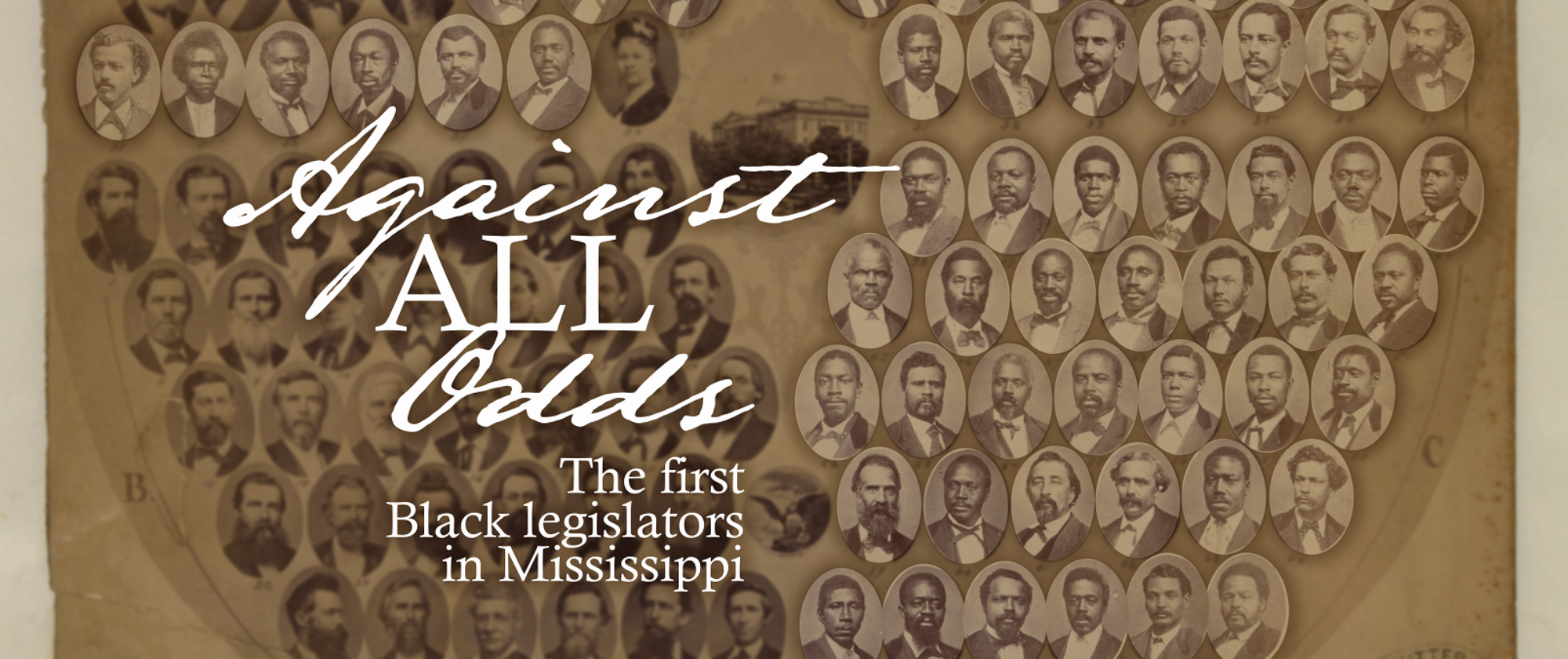

HON. GEO. H. HOLLAND.
The last sad offices – Action in the Senate and House – At the Methodist Church – At the Cemetery, etc.
[excerpts]
Early Wednesday morning, both houses of the Legislature appointed Committees to act in concert in making arrangements for the funeral ceremonies of Hon. George H. Holland, late State Treasurer[.]
[…]
IN THE SENATE.
Senator Gray, of Washington county, offered the following resolutions:
Whereas, It has pleased an All-wise Providence to suddenly remove the Hon. George H. Holland, late State Treasurer, from the midst of his usefulness, full of honors and of good report among his fellow-men with whom he had lived fifty-five years, thirty-eight of which he was a citizen of Mississippi, having been born in Alabama; and
Whereas, His life had displayed all the virtues of a consistent Christian, devoted husband, kind father, judicious friend, excellent neighbor, and able officer, therefore,
Resolved, That through this dispensation the State of Mississippi has been deprived of one of its ablest, most diligent, and most honorable officers.
Resolved, That we tender his bereaved family our heartfelt sympathy in this the deepest affliction which can possibly befall a Christian household.
Resolved, That in recognition of his services as an officer of the State Government, our appreciation of our loss, in token of sympathy with his deeply bereaved family, and to show such respect as we can to his memory, the Senate do now adjourn. Resolution adopted, and the Senate at 12:30 adjourned.
[…]
IN THE HOUSE.
The special committee appointed to draft resolutions of respect, offered the following:
Whereas, It has pleased Almighty God, in his infinite wisdom and power, to remove from our midst the Hon. Geo. H. Holland, late State Treasurer, of Mississippi; and,
Whereas, We do recognize in his death the loss of an eminently distinguished and capable functionary, a highly esteemed and useful citizen and an honest man, who in all of his various and manifold relations, both in public and private life, has ever won the confidence of his fellows by his strict adherence to the principles of truth, liberty and justice as well as by his loyal and steadfast devotion to the great principles of American Government, with which his whole life has been identified, and of which he was so prominent and honorable an exponent, by his services in the Constitutional Convention of 1868, as also by his earnest and indefatigable labors as an honorable member of this body during the four years preceding his election to the high and important office which his death now leaves vacant, and who, irrespective of party prejudice and opposition, has ever, by his uniform consistency and personal bearing, elicited the confidence and praise of those with whom he has either publicly or privately been associated.
Resolved, That this House tenders to the family of the deceased the expression of its earnest sympathy in their affliction and bereavement, and that the Clerk of this House be directed to transmit a copy of these proceedings to the family of the deceased, as also the Senate; and be it also
Resolved, That, as a further testimony of respect for the memory of the deceased, this House do now adjourn until tomorrow morning at 10 o’clock, to allow the members of this body to attend his last obsequies, at which it is recommended, as the sense of this House that the usual badges of mourning be worn; and be it further
Resolved, That the Sergeant-at-Arms be directed to drape this hall in mourning for the space of thirty days.
WM. LANDERS,
J. M. ECKFORD,
O. C. FRENCH.
Committee.
In the discussion of the same, Mr. Shorter of Hinds, said:
REMARKS OF HON. J. A. SHORTER.
Again we are called upon to mourn over the departure of one whom we have been in the habit of meeting in friendship. Of his outgoings and incomings we have all been cognizant, for he has occupied a position of trust, and all eyes have been directed toward him. He could bear the scrutiny. In all things he was upright, and everywhere and under all circumstances, he was exactly just. If anything, he was too lenient toward the faults of others. Giving way for others who will speak more eloquently than I, in his honor, though none regret his death more, I say with reverence, requiescat in pace.
REMARKS OF MR. GAYLES, OF BOLIVAR.
Mr. Speaker and gentlemen of the House of Representatives: I feel called upon to say a few words in commemoration of the virtues of our lost friend. I had the honor to serve with him two years in this body. In that time I learned to know him intimately. In all his relations he was an honest man, never swerving an iota from his trust. He is gone, and we regret this the more because such men as he can be so illy spared at this time. But he has left us the benefit of his virtuous example. Because in this example the best of him yet lives, and always will. No –
“There is no death. An Angel from Heaven
Walks o’er the earth with solemn tread
And tears loved ones away,
And then we call them dead.
“There is no death. The stars go down,
To set upon some fairer shore,
And in Heaven’t bright jewelled crown
They shine forever more.”
[…]
REMARKS OF MR. JOHNSON, OF DESOTO.
Mr. Speaker: It is with sadness that I rise for the purpose of paying the last tribute of respect to the Hon. G. H. Holland. When I heard of the death of the honorable gentleman, I could not realize that it was possible that the sad intelligence was true; but such is the case. “What man is it, that is born, that shall not see death?” When we begin to live, we begin to die. I have known the honorable gentleman for many years. He was always just, liberal and upright, and had but few equals among his fellows. In his death, we have lost one of our best citizens – one who has battled for the rights of all alike. I reconcile my grief and sadness on this occasion, on the ground that all must die – the rich, the high, the low and proud. Our friend has paid the last debt. He was true to his professions, and a friend of the oppressed and down-trodden, and my race has lost one of their best friends, and the State one of its best citizens.
[…]
REMARKS OF MR. RANDOLPH, OF LEFLORE.
Mr. Speaker: I am not well to-day, and I am willing to confess that I am one of those who are not able to do justice to the honored dead. His name and all that made him great and estimable, and which now make him so great and memorable, far outstrips any effort on my humble part to successfully eulogize him. But I cannot let the opportunity pass (for I would sadly regret it) without saying at least a word, to add to that which does him honor. This is no untimely tribute. Even more than what we are offering to his memory could be offered, and still there would be room for more. The gentleman, in departing this life, has left an unstained character and a name which does even the dead honor, and, although his course through life was fraught with troubles, and sometimes with almost insurmountable ones, yet, Mr. Speaker, with his mighty weapon – his strong intellect – he battled his way through, and when he died, he had gained one of the highest positions in the esteem of the people. But alas for him, his frail but towering frame has fallen, and the spirit hath taken its flight. But he has well performed his part in life. The paths of life are often obstructed with apparent dangers, and many weak ones are apt to fall or turn by the way. Not so with George H. Holland; for, with him, it was a high ambition to encounter these difficulties and to combat and disperse all that forbade his march. Then his love for liberty, too, was as abundant as his other great desire for the welfare of man, and in performing the duties of all his posts in life, he stood up for the best interest of all men, and he had learned to know no man on account of his color, and this, this alone, commends him to our consideration and favor, and also to posterity. Let the resolutions be adopted. Let us speak of his name and character, and send out our expressions to widen his well-known fame and name. Let those who knew him still better than myself speak of him. They are many, and can do him great honor and reverence. I would say more, but I am not able, and only regret that I am not. Let the resolutions be adopted.
REMARKS OF HON. J. D. CESSOR, OF JEFFERSON.
Mr. Speaker: I feel myself called upon to say something on this solemn occasion. It would be presumption on my part to attempt to improve upon anything that has already been said, but, sir, I cannot stand here silent and lose this opportunity of expressing my appreciation of the honored dead. He was one of the few, that we met in our daily intercourse with human nature, that was ever ready and willing to extend the hand to greet you, and would raise his voice to protect the weak and unfortunate. I have sat with him in counsel, and if I am any judge of human nature, I could see in the deceased all that nobleness and goodness of character that places one man so much above another. In the darkest hours of our late struggle, when the political clouds seemed to be gathering thick and fast and threatened to destroy the prospects of the colored man, he was one of the first to come forward and hold out the helping hand to the weak and untutored of my race, and to assist them in the discharge of the duties devolving upon them, intelligently. I regard him as one of Mississippi’s greatest and noblest sons. The time has come when he has been called to stand before the bar of a good and merciful Father, there to render an account of his stewardship while sojourning on this sinful earth. I hope that he did not leave us unprepared to meet his God, and we may soon follow this great and good man. So let us try to be also prepared.
REMARKS OF MR. SMOTHERS, OF CLAIBORNE COUNTY.
Mr. Speaker: I served two years with the deceased on this floor. In that time I never felt called upon to rise and second any motion. To-day I feel it my duty to say one word in regard to this question and in favor of these resolutions. Until a few minutes ago I did not know where Mr. Holland was born. It did not matter. He honored any place where he might live, because all his acts were in perfect keeping with the life of a good and honest man. Mr. Speaker, I will only add, that I hope and believe these resolutions will pass without a dissenting voice.
MR. ROGERS, OF MARSHALL.
Mr. Speaker: I rise to speak in behalf of these resolutions. Do what we may we cannot show our regrets for our loss in as strong a manner as we could wish. And are we only honoring the man because he is a Republican? I think not. The first bell which tolled out the mournful tidings, in my town, that Gen. Robert E. Lee was dead, was the bell of the University, in which colored children alone are educated. Nor do I rise because I happened to be born in the same State with the deceased. I honor him for the same reason that has caused so many of the members upon the opposite side of the House to speak in favor of these resolutions. No higher honor could be paid him. I honor him because he was that noblest work of God – a truly honest man. We cannot do too much to show honor to his memory. He was the friend of my race, but he was equally the friend of all others who deserve the good will of a good man. But, in our grief, we are fortunate in being able to say: “The Lord gave, and the Lord hath taken away; blessed be the name of the Lord.” We are fortunate, because we know we are speaking of a departed Christian, who is now at peace above.