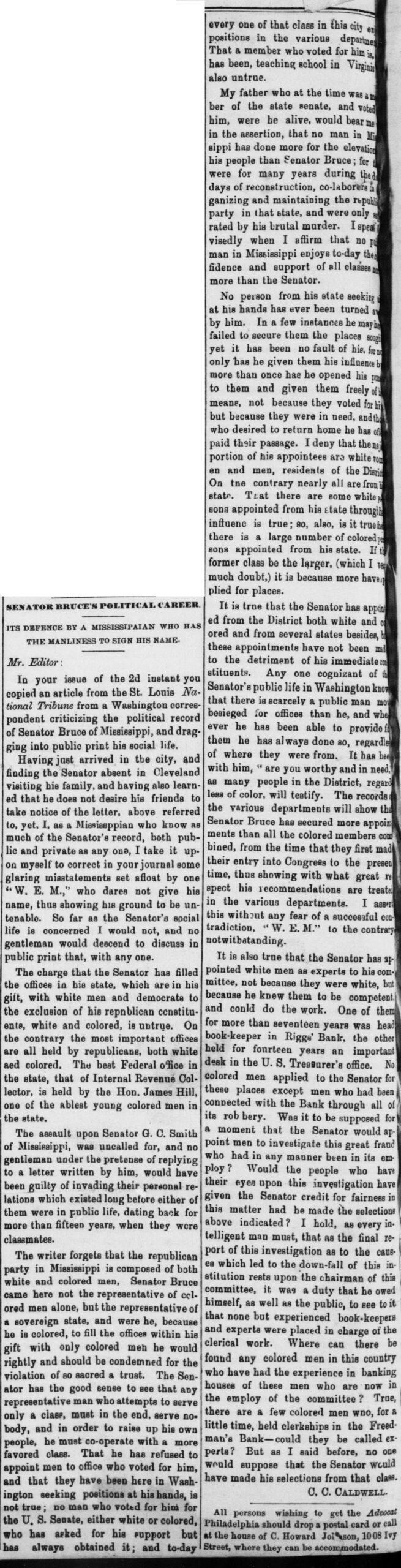
(letter from C. C. Caldwell, son of Charles Caldwell, to The People’s Advocate newspaper in Washington, DC, defending Blanche K. Bruce)
SENATOR BRUCE’S POLITICAL CAREER.
ITS DEFENCE BY A MISSISSIPPIAN WHO HAS THE MANLINESS TO SIGN HIS NAME.
Mr. Editor:
In your issue of the 2d instant you copied an article from the St. Louis National Tribune from a Washington correspondent criticizing the political record of Senator Bruce of Mississippi, and dragging into public print his social life.
Having just arrived in the city, and finding the Senator absent in Cleveland visiting his family, and having also learned that he does not desire his friends to take notice of the letter, above referred to, yet, I, as a Mississippian who know as much of the Senator’s record, both public and private as any one, I take it upon myself to correct in your journal some glaring misstatements set afloat by one “W. E. M.,” who dares not give his name, thus showing his ground to be untenable. So far as the Senator’s social life is concerned I would not, and no gentleman would descend to discuss in public print that, with any one.
The charge that the Senator has filled the offices in his state, which are in his gift, with white men and democrats to the exclusion of his republican constituents, white and colored, is untrue. On the contrary the most important offices are all held by republicans, both white and colored. The best Federal office in the state, that of Internal Revenue Collector, is held by the Hon. James Hill, one of the ablest young colored men in the state.
The assault upon Senator G. C. Smith of Mississippi was uncalled for, and no gentleman under the pretense of replying to a letter written by him, would have been guilty of invading their personal relations which existed long before either of them were in public life, dating back for more than fifteen years, when they were classmates.
The writer forgets that the republican party in Mississippi is composed of both white and colored men. Senator Bruce came here not the representative of colored men alone, but the representative of a sovereign state, and were he, because he is colored, to fill the offices within his gift with only colored men he would rightly and should be condemned for the violation of so sacred a trust. The Senator has the good sense to see that any representative man who attempts to serve only a class, must in the end, serve nobody, and in order to raise up his own people, he must co-operate with a more favored class. That he has refused to appoint men to office who voted for him, and that they have been here in Washington seeking positions at his hands, is not true; no man who voted for him for the U. S. Senate, either white or colored, who has asked for his support but has always obtained it; and to-day every one of that class in this city enjoys positions in the various departments. That a member who voted for him is, and has been, teaching school in Virginia is also untrue.
My father who at the time was a member of the state senate, and voted for him, were he alive, would bear me out in the assertion, that no man in Mississippi has done more for the elevation of his people than Senator Bruce; for they were for many years during the dark days of reconstruction, co-laborers in organizing and maintaining the republican party in that state, and were only separated by his brutal murder. I speak advisedly when I affirm that no public man in Mississippi enjoys to-day the confidence and support of all classes more than the Senator.
No person from his state seeking aid at his hands has ever been turned away by him. In a few instances he may have failed to secure them the places sought, yet it has been no fault of his, for not only has he given them his influence but more than once has he opened his purse to them and given them freely of his means, not because they voted for him but because they were in need, and those who desired to return home he has often paid their passage. I deny that the major portion of his appointees are white women and men, residents of the District. On the contrary nearly all are from his state. That there are some white persons appointed from his state through his influence is true; so, also, is it true that there is a large number of colored persons appointed from his state. If the former class be the larger, (which I very much doubt,) it is because more have applied for places.
It is true that the Senator has appointed from the District both white and colored and from several states besides, but these appointments have not been made to the detriment of his immediate constituents. Any one cognizant of the Senator’s public life in Washington knows that there is scarcely a public man more besieged for offices than he, and whenever he has been able to provide for them he has always done so, regardless of where they were from. It has been with him, “are you worthy and in need,” as many people in the District, regardless of color, will testify. The records of the various departments will show that Senator Bruce has secured more appointments than all the colored members combined, from the time that they first made their entry into Congress to the present time, thus showing with what great respect his recommendations are treated in the various departments. I assert this without any fear of a successful contradiction, “W. E. M.” to the contrary notwithstanding.
It is also true that the Senator has appointed white men as experts to his committee, not because they were white, but because he knew them to be competent, and could do the work. One of them for more than seventeen years was head book-keeper in Riggs’ Bank, the other held for fourteen years an important desk in the U. S. Treasurer’s office. No colored men applied to the Senator for these places except men who had been connected with the Bank through all of its robbery. Was it to be supposed for a moment that the Senator would appoint men to investigate this great fraud who had in any manner been in its employ? Would the people who have their eyes upon this investigation have given the Senator credit for fairness in this matter had he made the selections above indicated? I hold, as every intelligent man must, that as the final report of this investigation as to the causes which led to the down-fall of this institution rests upon the chairman of this committee, it was a duty that he owed himself, as well as the public, to see to it that none but experienced book-keepers and experts were placed in charge of the clerical work. Where can there be found any colored men in this country who have had the experience in banking houses of these men who are now in the employ of the committee? True, there are a few colored men who, for a little time, held clerkships in the Freedman’s Bank – could they be called experts? But as I said before, no one would suppose that the Senator would have made his selections from that class.
C. C. CALDWELL.