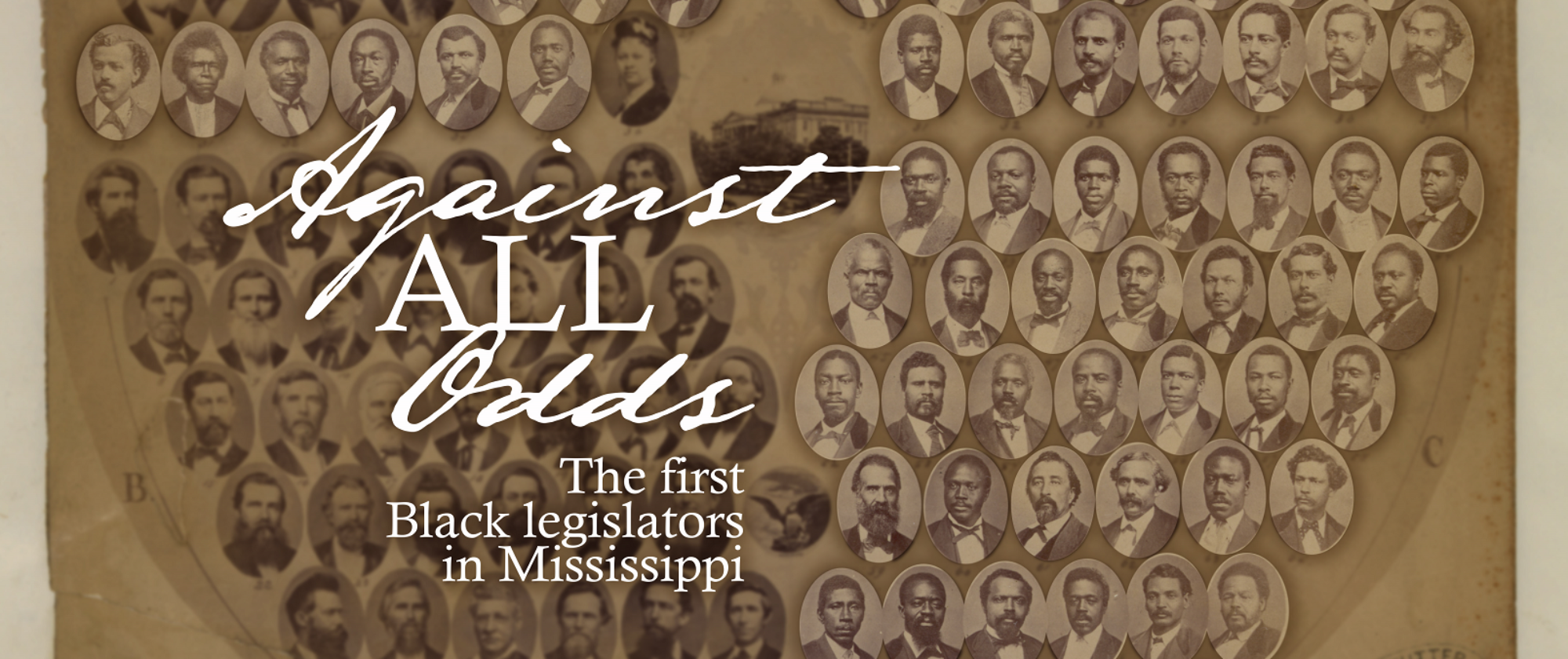
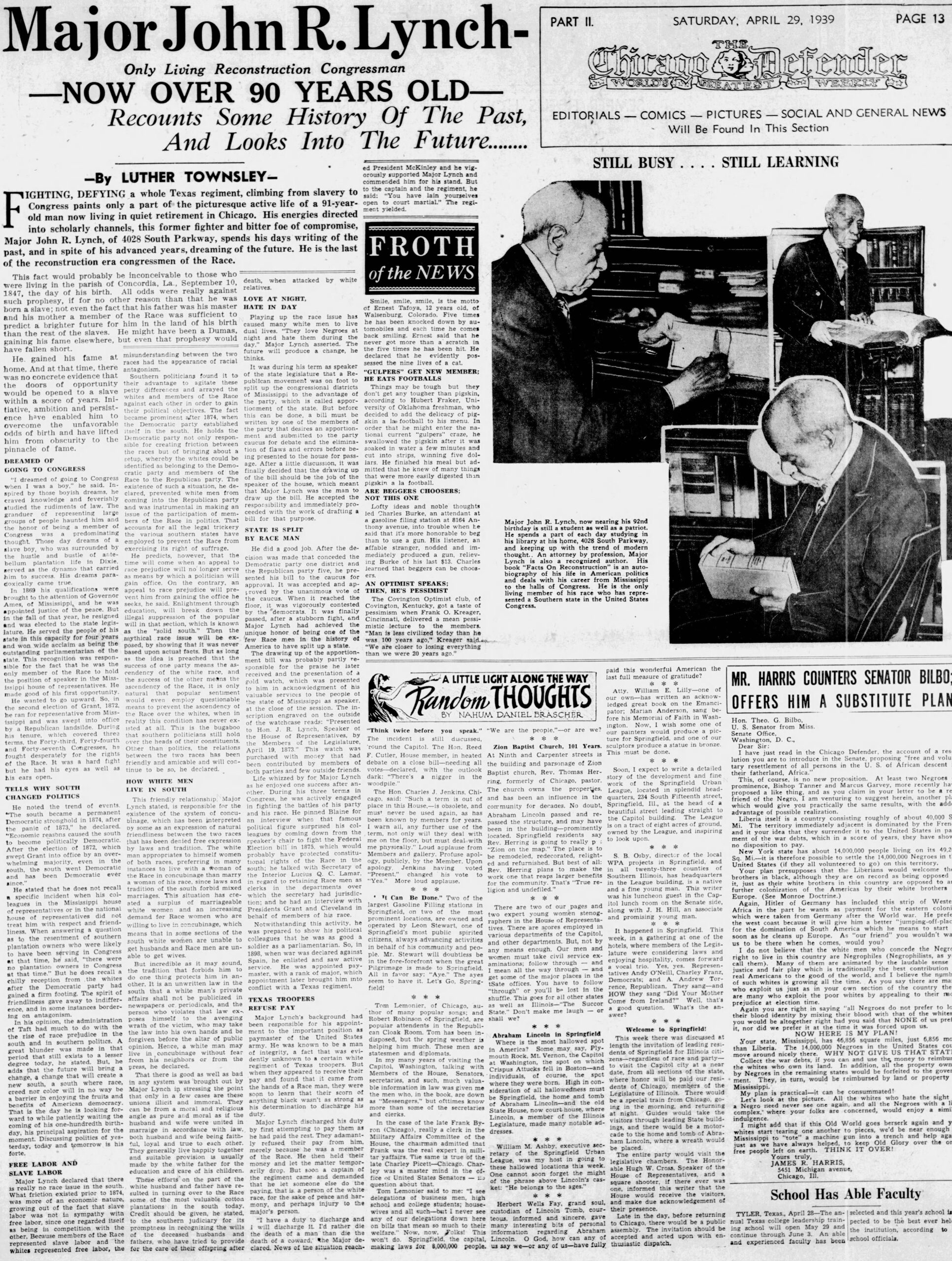
Major John R. Lynch
Only Living Reconstruction Congressman
NOW OVER 90 YEARS OLD
Recounts Some History Of The Past, And Looks Into The Future…..
By LUTHER TOWNSLEY
Fighting, defying a whole Texas regiment, climbing from slavery to Congress paints only a part of the picturesque active life of a 91-year-old man now living in quiet retirement in Chicago. His energies directed into scholarly channels, this former fighter and bitter foe of compromise, Major John R. Lynch, of 4028 South Parkway, spends his days writing of the past, and in spite of his advanced years, dreaming of the future. He is the last of the reconstruction era congressman of the Race.
This fact would probably be inconceivable to those who were living in the parish of Concordia, La., September 10, 1847, the day of his birth. All odds were really against such prophesy, if for no other reason than that he was born a slave; not even the fact that his father was his master and his mother a member of the Race was sufficient to predict a brighter future for him in the land of his birth than the rest of the slaves. He might have been a Dumas, gaining his fame elsewhere, but even that prophesy would have fallen short.
He gained his fame at home. And at that time, there was no concrete evidence that the doors of opportunity would be opened to a slave within a score of years. Initiative, ambition and persistence have enabled him to overcome the unfavorable odds of birth and have lifted him from obscurity to the pinnacle of fame.
DREAMED OF GOING TO CONGRESS
“I dreamed of going to Congress when I was a boy,” he said. Inspired by those boyish dreams, he craved knowledge and feverishly studied the rudiments of law. The grandeur of representing large groups of people haunted him and the honor of being a member of Congress was a predominating thought. Those day dreams of a slave boy, who was surrounded by the hustle and bustle of antebellum plantation life in Dixie, served as the dynamo that carried him to success. His dreams paradoxically came true.
In 1869 his qualifications were brought to the attention of Governor Ames, of Mississippi, and he was appointed justice of the peace. But in the fall of that year, he resigned and was elected to the state legislature. He served the people of his state in this capacity for four years and won wide acclaim as being the outstanding parliamentarian of the state. This recognition was responsible for the fact that he was the only member of the Race to hold the position of speaker in the Mississippi house of representatives. He made good of his first opportunity.
He wanted to go upward. So, in the second election of Grant, 1872, he ran for representative from Mississippi and was swept into office by a Republican landslide. During his tenure, which covered three terms, the Forty-third, Forty-fourth and Forty-seventh Congresses, he fought desperately for the rights of the Race. It was a hard fight but he had his eyes as well as his ears open.
TELLS WHY SOUTH CHANGED POLITICS
He noted the trend of events. “The south became a permanent Democratic stronghold in 1874, after the panic of 1873,” he declared. “Economic reasons caused the south to become politically Democratic. After the election of 1872, which swept Grant into office by an overwhelming majority, even in the south, the south went Democratic and has been Democratic ever since.”
He stated that he does not recall a specific incident when his colleagues in the Mississippi house of representatives or in the national house of representatives did not treat him with respect and friendliness. When answering a question as to the resentment of southern plantation owners who were likely to have been serving in Congress at that time, he said, “There were no plantation owners in Congress at that time.” But he does recall a chilly reception from the whites after the Democratic party had gained a firm footing. The spirit of friendliness gave away to indifference, and in some instances bordering on antagonism.
In his opinion, the administration of Taft had much to do with the rise of race prejudice in the south and in southern politics. A great blunder was made in that period that still exists to a lesser degree today, he stated. But, he adds that the future will bring a change, a change that will create a new south, a south where race, creed nor color will in no way be a barrier in enjoying the fruits and benefits of American democracy. That is the day he is looking forward to while patiently waiting the coming of his one-hundredth birthday, his principal aspiration for the moment. Discussing politics of yesterday, today and tomorrow is his forte.
FREE LABOR AND SLAVE LABOR
Major Lynch declared that there is really no race issue in the south. What friction existed prior to 1874, was more of an economic nature, growing out of the fact that slave labor was not in sympathy with free labor, since one regarded itself as being in competition with the other. Because members of the Race represented slave labor and the whites represented free labor, the misunderstanding between the two races had the appearance of racial antagonism.
Southern politicians found it to their advantage to agitate these petty differences and arrayed the whites and members of the Race against each other in order to gain their political objectives. The fact became prominent after 1874, when the Democratic party established itself in the south. He holds the Democratic party not only responsible for creating friction between the races but of bringing about a setup, whereby the whites could be identified as belonging to the Democratic party and members of the Race to the Republican party. The existence of such a situation, he declared, prevented white men from coming into the Republican party and was instrumental in making an issue of the participation of members of the Race in politics. That accounts for all the legal trickery the various southern states have employed to prevent the Race from exercising its right of suffrage.
He predicts, however, that the time will come when an appeal to race prejudice will no longer serve as means by which a politician will gain office. On the contrary, an appeal to race prejudice will prevent him from gaining the office he seeks, he said. Enlightenment through education, will break down the illegal suppression of the popular will in that section, which is known as the “solid south.” Then the mythical race issue will be exposed, by showing that it was never based upon actual facts. But as long as the idea is preached that the success of one party means the ascendency of the white race, and the success of the other means the ascendency of the Race, it is only natural that popular sentiment would even employ questionable means to prevent the ascendency of the Race over the whites, when in reality this condition has never existed at all. This is the bugaboo that southern politicians still hold over the heads of their constituents. Other than politics, the relations between the two races has been friendly and amicable and will continue to be so, he declared.
HOW WHITE MEN LIVE IN SOUTH
This friendly relationship, Major Lynch stated, is responsible for the existence of the system of concubinage, which has been interpreted by some as an expression of natural friendliness between the two races that has been denied free expression by laws and tradition. The white man appropriates to himself women of both races, preferring in many instances to live with a woman of the Race in concubinage than marry a woman of his race, since laws and tradition of the south forbid mixed marriages. This situation has created a surplus of marriageable white women and an increasing demand for Race women who are willing to live in concubinage, which means that in some sections of the south, white women are unable to get husbands and Race men are unable to get wives.
But incredible as it may sound, the tradition that forbids him to do one thing protects him in another. It is an unwritten law in the south that a white man’s private affairs shall not be publicized in newspapers or periodicals, and the person who violates that law exposes himself to the avenging wrath of the victim, who may take the law into his own hands and be forgiven before the altar of public opinion. Hence, a white man may live in concubinage without fear from his neighbors or from the press, he declared.
That there is good as well as bad in any system was brought out by Major Lynch in stressing the point that only in a few cases are these unions illicit and immoral. They can be from a moral and religious angle as pure and moral as if the husband and wife were united in marriage in accordance with law, both husband and wife being faithful, loyal and true to each other. They generally live happily together and suitable provision is usually made by the white father for the education and care of his children.
These efforts on the part of the white husband and father have resulted in turning over to the Race some of the most valuable cotton plantations in the south today. Credit should be given, he stated, to the southern judiciary for its promptness in recognizing the wills of the deceased husbands and fathers, who have tried to provide for the care of their offspring after death, when attacked by white relatives.
LOVE AT NIGHT, HATE IN DAY
Playing up the race issue has caused many white men to live dual lives. “They love Negroes at night and hate them during the day,” Major Lynch asserted. The future will produce a change, he thinks.
It was during his term as speaker of the state legislature that a Republican movement was on foot to split up the congressional districts of Mississippi to the advantage of the party, which is called apportionment of the state. But before this can be done, a bill must be written by one of the members of the party that desires an apportionment and submitted to the party caucus for debate and the elimination of flaws and errors before being presented to the house for passage. After a little discussion, it was finally decided that the drawing up of the bill should be the job of the speaker of the house, which meant that Major Lynch was the man to draw up the bill. He accepted the responsibility and immediately proceeded with the work of drafting a bill for that purpose.
STATE IS SPLIT BY RACE MAN
He did a good job. After the decision was made that conceded the Democratic party one district and the Republican party five, he presented his bill to the caucus for approval. It was accepted and approved by the unanimous vote of the caucus. When it reached the floor, it was vigorously contested by the democrats. It was finally passed, after a stubborn fight, and Major Lynch had achieved the unique honor of being one of the few Race men in the history of America to have split up a state.
The drawing up of the apportionment bill was probably partly responsible for the praise he later received and the presentation of a gold watch, which was presented to him in acknowledgment of his valuable services to the people of the state of Mississippi as speaker, at the close of the session. The inscription engraved on the outside of the watchcase reads: “Presented to Hon. J. R. Lynch, Speaker of the House of Representatives, by the Members of the Legislature, April 19, 1873.” This watch was purchased with money that had been contributed by members of both parties and few outside friends.
Life whizzed by for Major Lynch as he enjoyed one success after another. During his three terms in Congress, he was actively engaged in fighting the battles of his party and his race. He pinned Blaine for an interview when that famous political figure surprised his colleagues by coming down from the speaker’s chair to fight the Federal Election bill in 1875, which would probably have protected constitutional rights of the Race in the south; he talked with Secretary of the Interior Lucius Q. C. Lamar, in regard to retaining Race men as clerks in the departments over which the secretary had jurisdiction; and he had an interview with Presidents Grant and Cleveland in behalf of members of his race.
Notwithstanding this activity, he was prepared to show his political colleagues that he was as good a soldier as a parliamentarian. So, in 1898, when war was declared against Spain, he enlisted and saw active service. He was appointed paymaster, with a rank of major, which appointment later brought him into conflict with a Texas regiment.
TEXAS TROOPERS REFUSE PAY
Major Lynch’s background had been responsible for his appointment to the important position as paymaster of the United States army. He was known to be a man of integrity, a fact that was evidently unknown to a certain white regiment of Texas troopers. But when they appeared to receive their pay and found that it came from the hands of a Race man, they were soon to learn that their scorn of anything black wasn’t as strong as his determination to discharge his duty.
Major Lynch discharged his duty by first attempting to pay them as he had paid the rest. They adamantly refused their pay from him, merely because he was a member of the Race. He then held their money and let the matter temporarily drop. But soon a captain of the regiment came and demanded that he let someone else do the paying, that is, a person of the white race, for the sake of peace and harmony, and perhaps injury to the major’s person.
“I have a duty to discharge and I will discharge it. I’d rather die the death of a man than die the death of a coward,” the Major declared. News of the situation reached President McKinley and he vigorously supported Major Lynch and commended him for his stand. But to the captain and the regiment, he said: “You have lain yourselves open to court martial.” The regiment yielded.