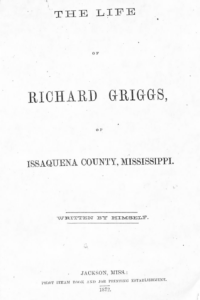
 The Life of Richard Griggs of Issaquena County, Mississippi
Written by Himself.
Jackson: Pilot Steam Book and Job Printing Establishment, 1872.
This publication was included in Mariah Griggs’ widow’s pension file, available here (PDF) on pages 29-35. Original held at the US National Archives.
RICHARD GRIGGS, the subject of this history, was born in Hardeman county, Tennessee, on 10th day of January, 1839, of slave parents, who belonged to a very prominent lawyer of that place, by the name of David Fentress; and I was the slave of the same man, who raised me as his body servant. When I was about 14 years of age my master and his wife parted, on account of some family disagreement. He left home and took quarters at Union Hotel, in Bolivar county. He took with him my mother, two sisters, and myself, all of whom, except myself, hired their time, I remaining at the hotel with him. We stayed at the hotel about three years, at the end of which time my master died, and I was left without a master, and simply a common chattel, according to the laws of that State.
I was sold to a Mr. Woods, a great railroad contractor, who told me he wanted to learn me to work. I told him I would not work on the railroad, as I had never done any such work, and greatly preferred remaining at the hotel. My master’s brother, the man who had sold me, had a very serious objection to my staying there, and told me he had sold me to Mr. Woods, and I must go with him; when I politely replied that I would not work on a railroad for Mr. Woods nor any other man, but wanted to stay in town.
I was next attacked by my master’s son, who urged me to go home with Mr. Woods, telling me I would have a good home and the like. I felt considerably troubled about the matter, and told him I would not go, as I had made up my mind to be a slave no longer, having been set free by his father before his death, and the will recorded to that effect.
Having fully made up my mind to become a free man, I went to my mother and told her to prepare my clothes, as I intended to leave that night. My mother became quite uneasy about me, and seemed afraid for me to start. After bidding farewell to my mother, I went to the stable of a lawyer in the town, who had a very fine horse, and stole the horse, saddle and bridle, not thinking it any harm to steal a horse upon an occasion like that. I mounted the horse and started for a little town, about ninety miles distance, called Hernando. The night was very dark and rainy, but I made a safe journey, and got to Hernando by 8 o’clock next morning, and expected to meet a boat there for Memphis, but unfortunately for me, I found no boat there, the past night being quite stormy, the boat was behind time, and I had to lay over until evening. During the suspense I felt quite uneasy, and in the midst of these unpleasant feelings I looked down the river and saw the boat coming, and then looking in another direction, I saw the owner of the horse, and two other men in company with him, in pursuit of me and the stolen horse. As a matter of course I felt pretty bad. They went to the livery stable, found the horse and upon inquiry, found that a negro boy by the name of Richard had rode him there. He then began a search for me and found me. He approached me with his pistol in hand and asked me why I stole his horse, threatening at the same time to shoot me. I told him that I did not intend to carry his horse off, but as he had the best horse in town, I simply desired to ride him as far as Hernando. He asked me if I was willing to go back home with him. I told him I was. After getting our dinner we started for Covington, the county seat, and got there about 10 o’clock that night; I was put in jail, with no other company save the rats, which were of no ordinary size; I was taken out next morning and carried to the town of Bolivar, my old home, and was then put in jail; staid there in jail until about 12 o’clock that night, when I was taken out and carried to Grand Junction; there I was put on the cars and carried to Memphis, where I was put in a trader’s yard and chained for six months, at the expiration of which time I was brought out and put in the sale room to be sold. The sale master told me to put on my best appearance, assist in my sale and he would give me fifty dollars of the money. There soon came a man in by the name of Bridgeforth, who examined me and liked me very much; he then bought me, at a cost of eleven hundred and fifty (1,150) dollars. He then started home with me. He lived about twenty-eight miles south of Memphis. We got there about 12 o’clock at night, and to my astonishment I found his hands (about seventy-five in number, men, women and children), just coming out of the field. He carried me to his dwelling-house, in order that his wife might see me; and then we had a conversation before her. She looked at me and said she thought I would make a fine carriage driver. The next morning I formed the acquaintance of some of the men on the place. Among them was one who was in the habit of running away. I took a particular fancy to him. I invited him to walk around the plantation with me, as I desired to talk with him. While we were gone this white man went and put a pack of hounds on our track, thinking that we had run off. We heard the dogs and went back to the house. He soon rode up to where I was sitting, and said I thought you had run off. I told him, oh no, that when I got tired of the place I would come and let him know. He told me that a negro could not get away in that country. That night he placed a guard over me. The young man whom he put to guard me, generally arose before day to go to his work. Being a field hand, he had to cook his meals over night for the next day. Being greatly tired and wearied, after cooking an ash-cake, small piece of meat, and getting his bottle of molasses, he set down and soon dropped off to sleep and left me to guard him. I had made an arrangement between myself and the man that I was with during the day to run off that night. After finding the guard asleep, I quietly stole to him, took what grub he had cooked, went out, locked him up and threw away the key. I met my colleague at the place appointed, with two of our master’s finest horses. We mounted them and put out for the depot, which was about seventeen miles, and got there safe.
During my first master’s life his boys had learnt me to write. After getting to the depot I wrote myself and companion a pass over the road. I handed the pass to the conductor, which stated that myself and companion were in search of some stray mules of my master’s, and this was to permit us to pass from there to Bolivar. We intended going immediately from there to Nashville, and from thence to the Northern States. The train arrived at Bolivar, and to my surprise and regret, in stepped two Bolivar men, who said they had a dispatch for our arrest. My companion became quite alarmed, and said to me, “I thought you were going to get me in trouble.” I told him it would be all right soon. As a matter of course they put us in jail, where we found quite a crowd, composed of both white and colored, who were put in there for various offenses. We were all in one large cell. After viewing the situation for a day or so, I began to form an arrangement for getting out, and found all very anxious to escape. I laid my plan before them and it met their hearty approval. I then moved the previous question and cut off all debate. The jailor, on coming to feed us, had to pass through three doors, and would leave a guard at each one. My companion was a very heavy, large fellow. He was to knock down the man who stood at the door and handed in our grub. One of the white prisoners was to fix the jailor, who stood at the next door, and I was to settle the jailor’s wife, who stood at the third door with a candle in her hand. At the hour for supper the doors were heard to unlock. Our men began to take their position for escape; my companion taking first stand at the door. Soon came the man, opened the cell door and handed in our supper, when my companion, by a well-directed blow, knocked the feed man down; out we rushed, knocked the next one down, then came to the women, whom I slapped down and out we went. After getting outside I lost sight of my companion, and saw him no more. We scattered in different directions.
After getting out of jail I went up town and called on my mother, who was greatly surprised to see me. I changed my clothing, got a little money from my mother and went to Memphis. After getting to Memphis I hired myself to a cotton merchant and worked for him three months. One day, while walking along the street, I had the pleasure (?) of meeting my late master, who was surprised to see me, and I was as much surprised to see him. He recognized me after passing a few steps by me, and asked me if I was not the boy he had bought at the trader’s yard in that city a short time before. I told him I thought I was, which seemed to please him very much. He asked me if I would go to the trader’s yard and be sold. I told him certainly. He then took me to the yard and sold me for what I cost him. He said he thanked the Lord for his good fortune, bid me good-by and left. So ended second master.
THIRD MASTER.
I had the very distinguished honor of next belonging to the Nation’s Southern Chief, the Knight of the Bloody Spur – N. B. Forrest. I staid in his yard about seven weeks. There were two young men in the yard who desired to run away and requested me to write them passes, which I did. They wished to go to Virginia. After traveling about one hundred miles they were caught and brought back. They told Mr. Forrest that I had written them passes. He told me he never wanted me to do that again while I remained in his yard. He soon after sold me to a man in Arkansas, named McGregory. So commences
MASTER THE FOURTH.
McGregory lived about twenty-five miles west of Memphis, in the State of Arkansas. He told me that he wanted me to attend to the ferry across Black Fish lake, where he lived. Black Fish lake was quite a summer resort, and I had a great deal to do, as ferryman, in putting travelers across. On the opposite side of the lake stood a very nice hotel, owned and run by master the fourth. He was seldom at home, and consequently left all the business with me to attend to. When I first went there I did not intend staying there longer than ten or twelve days, but finding that I could make some extra dimes for myself, I remained quite awhile. After ferrying for a month or so, I was then promoted to chicken peddler for the hotel. I liked my new position very well. This country was thinly settled with colored people, there not being one in twenty miles of me, except one other owned by master the fourth; but very thickly settled with that class commonly known as “poor white people.” I had to go to Memphis about once a week to buy such provisions for the hotel as could not be bought in the country. My duties being quite light, and being such as I enjoyed, I concluded to stay a long while, as I was then making from three to four dollars per day. My master placed unbounded confidence in me, and thought me quite an honest fellow, and seemed to take quite an interest in me. He owned a very beautiful young woman. Myself and this woman constituted his entire slave property. He soon concluded to make her my wife; but I did not exactly agree with him in that, as I knew I had quite a weakness for running away, and under those circumstances I did not care to be bothered with a wife; so I concluded I would not marry, as I contemplated leaving as soon as I got money enough, and try my luck for a free State. This portion of the country in the fall became very sickly, being what is commonly known as swamp lands. I commenced to have chills and fever, and so concluded to move. I was very sick, and thought several times that master the fourth would lose his slave. Our nearest doctor was twenty miles off. But as the weather turned cool I began to improve, and soon got well again. After I got well they left this place and went over to the adjoining county where his father lived. He told me he intended to raise corn and stock there, and asked me what I thought of it. I told him I thought it poor idea. At any rate he concluded he would try it. So we set in and cleared up our lands. I being his only man slave, he agreed to work with me through the crop. After clearing our land we commenced to cultivate it and put in our crop. As the weather got warm master began to get tired of work, and I was glad of it. He would stop at one end of the row and take out his horse, and I would stop at the other end and follow suit. The corn and grass was then about the same height. We came in one very warm day, after being at work in the field, tired and wearied; master looked at me and I looked at him; he seemed to be discouraged, and he said to me thought he had better give up farming. I told him I thought so too. He went off, and when he came back he told me that he had sold the place, which I was very glad to hear. He went to a little town called Madison, and bought out a hotel, which met my unqualified approval. In two or three days we moved to our new home. It being situated on the St. Francis river, we had a boat to land there every two or three days. He opened the hotel and had quite a number of boarders. I, as a matter of course, was second boss. He run the hotel for three or four months. During that time he found out that I could write, which made him very uneasy. He told his wife he would have to sell me. She did not seem to like it much – I had become quite a favorite of hers. He told her he was compelled to sell me, as I could write and would get away. He came to me and said he was broke and would be compelled to sell me. I told him to do so. So commences
FIFTH MASTER.
Next day came a Mr. Taylor, who desired to buy a negro boy. Master the fourth brought him down to the hotel to see me. He looked at me and said he wanted to buy a boy to attend to his horses and wait around the house. I told him that I was for sale and he could buy me if he wished. He bought me at once, for the small sum of eleven hundred and fifty (1,150) dollars. He lived about eight miles from town, where he immediately carried me. According to the old rule, I was first commanded to appear before his wife for her inspection. She was very well pleased with my appearance. He then assigned me my duties at the stable as hostler. He told me he wished me to attend to his horses well and assist him in selling the same. I at once concluded that master the fifth and I could not get on well together, and in order to cause him to make immediate disposition of me, I went to the house and asked his wife to give me a sheet of paper, as I desired to write a letter. She seemed wonderfully astonished, and asked me if I could write. I informed that I could. She gave me the paper and asked me to sit down there and let her see me write. I did so. After I had wrote the letter she took it to look at, and satisfied herself that I could write. Master the fifth was not at home when this took place, but on arriving home his wife told him that it would never do for him to keep me; that I could write. He made up his mind to sell me to the first person that would buy me. The next day there came a man to the house by the name of Cobbs, who was on his way to Memphis to buy negroes. Master the fifth did not want me to know that he was going to sell me, and desired to sell me on the sly; so he tells Cobbs about me and brought him down to the stable to see me, but pretended that he wanted to try a horse. Cobbs was commonly styled a negro king. After going through and looking at the horses, he came to me and said: “You are a fine looking negro, what can you do?” I told him I could do anything. He and master the fifth went out and held a little conversation, after which he left our place and went to Memphis. He returned after a few days absence. He had bought me before he left, but I knew nothing of it. He went from there to a little place called Taylor’s creek. In order to get me there without my knowing the object, master the fifth came to me and told me he wanted me to go to the creek with him, as he wished to make me a present of a new hat. While we were in the store buying a hat, Mr. Cobbs came in with seven other men, and said to me, sir you belong to me. He pulled out a pair of handcuffs and put them upon my wrists, at the same time remarking that he would make a cotton picker of me. Before leaving I asked him to go over to the post-office and see if there was a letter there for me. He went and returned with two letters for me. He handed them to me, and asked me who was writing to me. I told him I did not know. He asked me if I could read. I told him I could. He opened the letters and told me to read them to him, which I did. He then asked me if could write. I did so, and he seemed wonderfully surprised. He cursed my former master for selling me to him, and commenced to get very kind to me, gave me some cigars and something to drink. He appeared to be very uneasy after finding out that I could write, and seemed to regret his trade. At any rate he carried me to his plantation and gave his overseer his orders about me, telling him he must treat me very kind, for I would run away for the least ill-treatment.
I soon formed the acquaintance of the overseer, who I considered a very bad man. As a swearer he was well accomplished. It being Sunday evening, he told me that on Monday morning I would see how negroes were treated there. So Monday, long before day, I heard the loud ringing of a bell, which was to call the hands out to work. I got up and went out to see the hands go out. I saw a man going across the yard with a chunk of fire in his hand – it was quite cold. The overseer saw him and ordered him to put it down, which he refused to do, when some four or five men were ordered to take him. The men did as they were ordered, and the man was taken down and most unmercifully whipped. The whipping made him mad, and he said he would carry fire to the field, and he did so. About sunrise I saw a large smoke in the field and this man standing at the fire, prepared for battle, with a scythe-blade in his hand, threatening to kill the first man that came to him. The overseer went to the house after the boss, who went down; but before going, he called me and told me he wanted me to go to the field with him, as he wished to show me how he managed his negroes. I went with him. When we got there he ordered the man to throw down the scythe-blade, which he at first hesitated to do, but finally did so. After putting it down he was taken to the road and hit about five hundred lashes; he was then put in a hogshead and rolled up and down the road for about two hours. I was satisfied with this exhibition of the manner in which he manged negroes, and concluded that I had better leave that country. My master seemed to anticipate my intentions, and he told me he would take me to Memphis on the first boat and sell me. In due time the boat came and I was taken to Memphis and sold immediately to one Green Little, a negro trader, for eleven hundred (1,100) dollars.
So now commences master the sixth. I remained with him only a short while. I was bought and sold so very fast that I could hardly give a correct account of the changes. My readers will be astonished when I tell them that I was bought and sold eighteen different times in three months. The last man who bought me lived in Memphis, with whom I remained until the late little unpleasantness broke out between the North and South, which resulted in the freedom of the negro. Having an opportunity of going to war and see men fight for that which I so much desired (freedom), I left Memphis with Gen. Logan’s division. There were no colored troops in the army at that time. I remained with that division until colored men were made soldiers, then I enlisted in the 48th United States colored infantry, at Lake Providence, La. I was made a Sergeant in company B, in which position I remained some time, until the Orderly was detailed for other duty, when I was made Orderly of the company. I remained in that position until the winter of 1864, when I was detailed by the Colonel as a recruiting officer, during which time I got in some two hundred recruits to the regiment. We at that time were in camp at Vicksburg. We were then ordered to Mobile. While on our way from Vicksburg to Mobile I was transferred from Co. B, to Co. H, as Orderly Sergeant, which position I held until after the fight at Mobile. I was then transferred as Quartermaster Sergeant, which position I held until mustered out of service, which took place in the winter of 1866, at Baton Rouge, La. I went from there to New Orleans and married.
Having passed successfully out of the hands of my many masters, and got through the war safe, and peace being now restored to our troubled country, I concluded I would go to the State of Mississippi. I had heard of Issaquena county, and thought I would go there and farm. I went up the river in the spring of 1866 and commenced farming. After planting my first crop, the cotton worm come plentifully and about closed me out. I felt very much discouraged, but concluded to try it again; so in 1867 I put in another crop, and was very sanguine of success, as crops bid very fair. But, alas, how often we see our hopes blasted! About the 15th of May there came an overflow, which completely destroyed my crop. Finding that farming was attended with so much uncertainty, I concluded I would stop and try something else for a living. About this time politics was all the go. We were called upon to send delegates to the Constitutional Convention which met at Jackson, in January 1868, after which the Constitution was submitted to the people and defeated. We were then to have an election in 1869 to elect members to the Legislature. Having been solicited by many of my friends to become a candidate to represent my county in the Legislature, I consented to run, and was elected by an overwhelming majority. After having served two years in the Legislature and given general satisfaction to my constituency, I was again urged to run for the office, and I yielded to the wishes of my friends, and was re-elected to the Legislature by equally as large a majority as before, thereby showing me that my course while in the Legislate was approved of by those whom I represented.
Now in conclusion, I can say, that while in the Legislature I endeavored to ameliorate the condition of my oppressed race in every way in my power, and I have the proud consolation of knowing that I have done something towards elevating them to a higher standard in life.