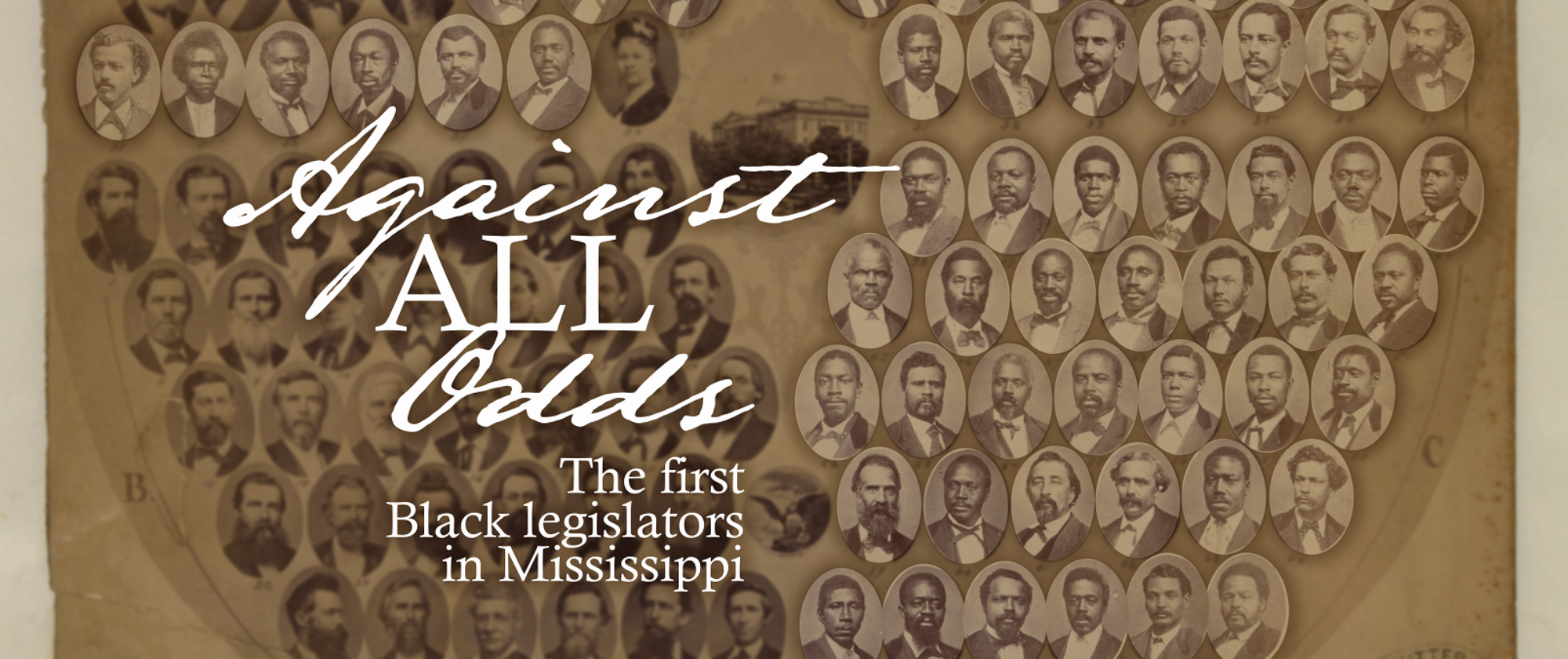
Mentions of legislators in excerpts from the Family Letters of Blanche Butler and Adelbert Ames (2 vols, 1957).
Diary of Blanche Ames, describing a speech by her husband – “His remarks were, in substance, as follows. I write from memory, therefore very incorrectly. I only desire to give the outline” – Natchez, November 20, 1870
“It gives me great satisfaction to observe the improved condition (political) of my colored friends, also that all the avenues to wealth and position are open to them, and that they seem eager, one and all, to take advantage of their opportunities. Pardon me, if I feel pleasure in reflecting that I had some agency in this great change, and that I recall to your minds the fact that when I took control of the destinies of the State there was not a single colored man in office. Mr. John R. Lynch, a fellow townsman of yours, I appointed Justice of Peace. Protest after protest came from members of the Democratic Party, who now profess to be your friends, against that opportunity, with no reason except the fact that he was colored. But I pursued unflinchingly the course I had marked out for myself. Now Mr. Lynch is no longer Justice of the Peace. Another man fills his place, and he is a member of the State Legislature, one of the most prominent men in the state.”
Adelbert to Blanche Ames, Jackson, April 19, 1873
“The legislature has adjourned, and the members are hastening to their homes…. The House, at least members thereof, gave the Speaker, Mr. Lynch (colored), a valuable gold watch and chain, and appropriate speeches were made by two of the colored members. They have no little tact and skill on such occasions, as well as on others. Mr. Lynch made a very pretty speech in reply.”
Adelbert to Blanche Ames, Jackson, August 28, 1873
“Today Mr. A. K. Davis, a colored man, was nominated for Lieut. Gov., and Mr. Hill, whom you met at Memphis, as Secretary of State. Mr. Davis is regarded as the next best man to Bruce, who would not run. Since I began I learn that a Judge Holland has been nominated for Treasurer. All are good men, and I am quite content.”
Adelbert to Blanche Ames, Jackson, October 31, 1873
“Again, a crowd of roughs were following our senators wherever they could find them, headed by the mayor of the city, with the intention, we believe, of getting up a row and then arresting them, to hold them for a number of hours without a hearing, that the senate should pass the bill. We also feared, and our fears were based on what our enemies dropped, that they would abduct some of our senators – take them out into the country and hold them for a day – which would be easier for them to do than to Ku Klux them, as would have been done, no doubt, two years ago.
Of course I am a sort of generalissimo at this time, and found all very ready to carry out any suggestions I might make. All agreed we should have the houses guarded in which our senators lived. So small squads of well-armed men were on hand ready for an emergency at every point. One of our men, Senator Caldwell, who lives ten miles from here on the R. R., went to his home not knowing or not fearing the efforts of our enemies. After we had made up our minds to guard our friends, we sent out to him a squad of armed men. Senator Campbell was arrested by one of the mob at the cars about midnight, but he was without authority, and soon released him. This morning we find all our friends here, and ready for the day’s work.”
Adelbert to Blanche Ames, Jackson, August 1, 1875
“Davis is in trouble. The legislature has a committee to inquire into his action in pardoning one Barratine. Barratine and a young friend went to cowhide a woman for speaking unkindly of Barratine’s sisters. This woman said that white girls, among them B’s. sisters, came to her house to meet men. The facts evidently sustained her in making the statement. B’s. friend was to hold her, perhaps whip her at the same time, but as she was strong, he could do no more than hold her, and while doing so Barratine shot her dead in her own house, in presence of her children. All this Lt. Gov. Davis told me yesterday. He said his chief reason for issuing the pardon was to suppress the scandal! The woman killed belonged to the class known as poor whites. The Barratines are “first families.” Davis is charged with selling the pardon, but I can hardly believe it. His action is creating, has created, much talk and is condemned by all.”
Adelbert to Blanche Ames, Jackson, September 24, 1875
“You ask what is to be done with Lt. Gov. Davis. This, – The charge against him of receiving a bribe for the pardon of young Barratine will be sustained (information received by me convinces me beyond a doubt of this fact). The charge sustained disqualified him and at the same time displaces him. A jury might disagree, to be sure, – but such a legislature as the Democracy expect would impeach him. In fact, the Democracy at the last extra session in July introduced resolutions of condemnation of his act, and would have tried to present articles had there been any hope.”
Blanche Ames to her mother, Jackson, December 8, 1875 [this letter must be misdated because Caldwell was murdered at the end of December]
I suppose you saw an account of the murder of Caldwell, a colored man, at Clinton. The only truthful part of that account was the statement that the man was shot. I will tell you the story, for it has made my blood boil many times within the last fortnight. Caldwell was State Senator last year, and he was one of the leaders in organizing the militia last fall (this was the reason of his murder). His nephew, a young fellow under twenty years of age, went over to Clinton and soon after his arrival was accosted by a white man, a member of the vigilance committee, who asked him if he was in the Clinton riot, and if he killed anyone. “No,” he said, “I did not kill anyone that I know of.” “Did you shoot at any one?” “I shot around, as the others did, when we were fired into.” The young fellow then went up to his Uncle ‘s house, but found that he had gone out fox-hunting. When Caldwell returned from the hunt and his nephew told him of the conversation, he said he would go down in the town and tell the man that the boy had done nothing at the riot. So far I have given you the boy’s story as near as I can remember as he told it to Gen’l. Ames. The rest is the recital of a Judge Cabinis of Clinton, who had pretended to be a friend of Caldwell. Caldwell recommended him to Gen’l. Ames for a judgeship, and was very strenuous about his appointment. There were some forty men around Caldwell when he fell back wounded into the cellar, and he called out “Oh Judge, Oh Judge, don’t leave me here to die like a dog.” At the same time the Judge was standing in the door of a store across the street with a gun in his hand ready to fire, with the other men, the moment Caldwell should show his head above the cellar door. Then Caldwell asked to be taken home. They went into the cellar and brought him out into the middle of the street. Someone cried “clear the road.” They dropped him, and like a flash, fifteen shots were fired into his body. This is the Judge’s story to Gen’l. Ames and his excuse for his conduct was that it was done to protect the life of a man by the name of Rice. A mere subterfuge. The Judge said that fifteen shots were fired into the body, but those who have seen Caldwell’s corpse report that the body had to be tied together, while on his head and neck there was not a space where one could lay a hand. After he was wounded, Caldwell said, “You may fire as many shots as you please, but you shall not say I did not die like a brave man.” His brother, hearing the shooting, rode into town to find out the cause of the fray, and was shot from his horse.
[…] The papers reported that Caldwell was drunk. On the contrary, he had just returned from hunting and went into the saloon to take a drink of settlement with the man who had questioned his nephew. He was fired upon when he attempted to come out. Enough of this story, but it shows you the condition of society, when the judges and principal men of the community bear a hand in such atrocities.”