The 1873 Civil Rights Law
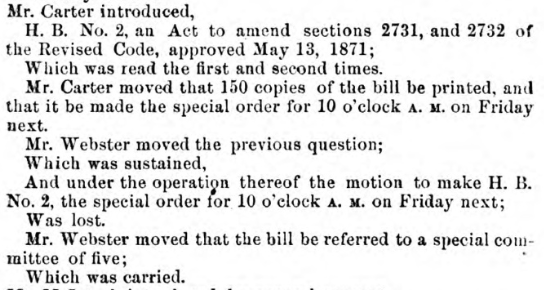
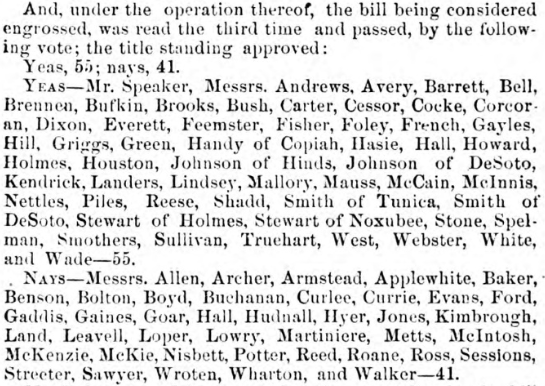
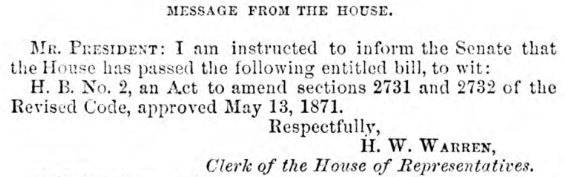
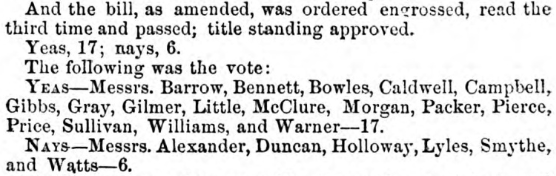
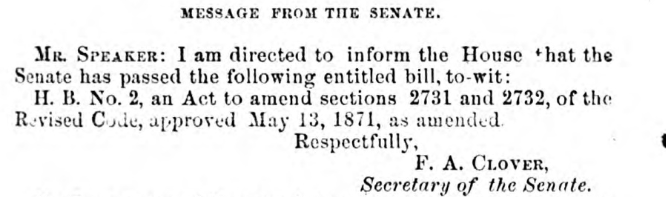
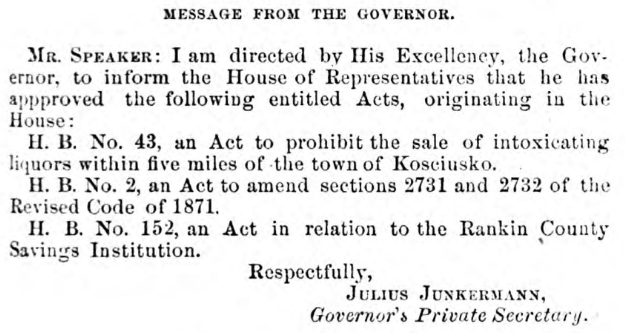
The bill, officially titled “an Act to amend sections 2731 and 2732 of the Revised Code of 1871,” was introduced by Hannibal C. Carter in the Mississippi House of Representatives on January 22, passed by the House on January 29, passed by the Senate on February 5, and signed by Governor Ridgley Powers on February 7. This newspaper article includes speeches by Powers, Carter, and A. K. Davis, celebrating the bill’s passage.
Text from Laws of the State of Mississippi, Passed at a Regular Session of the Mississippi Legislature Held in the City of Jackson, Commencing January 21, 1873, and Ending April 19, 1873, p. 66 (thanks to Judge Leslie Southwick).
CHAPTER LXIII.
AN ACT to amend Sections 2731 and 2732 of the Revised Code, approved May 13, 1871.
SECTION 1. Be it enacted by the Legislature of the State of Mississippi, That section two thousand seven hundred and thirty-one (2731), and section two thousand seven hundred and thirty-two (2732), of the Revised Code, approved May 13, A. D. 1871, be, and they are hereby amended to read as follows, to wit: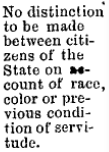 That all citizens of this State, without distinction of race, color or previous condition of servitude, are entitled to the equal and impartial enjoyment of any accommodation, advantage, facility or privilege furnished by common carriers running in or through, or plying within this State, whether upon land or upon waters, by any keeper, owners or lessee of any hotel, inn or restaurant, by any owner, managers or lessees of any theater or other place of public amusement, or of public entertainment or accommodation, and the equal and impartial enjoyment of any such accommodation, facility, privilege or advantage is hereby declared to have always been, is now, and shall forever remain a right inherent in every citizen or person, and which right shall not be denied, abridged or infringed on account of any distinction of race, color or previous condition of servitude; and any
  person who shall violate any of the foregoing provisions, or who shall deny to, or withhold from any person the enjoyment of any of the foregoing accommodations, facilities, privileges or advantages, equally and impartially on any such account, or for any such reason, or who shall abridge or infringe the same, or who shall incite thereto, shall be deemed guilty of a misdemeanor, and shall, on conviction before any Justice of the Peace or any Court having jurisdiction thereof, for each and every such offense, forfeit and pay to the person aggrieved thereby a sum of money which, in any case shall not be less than three hundred (300) dollars, to be recovered in any action on the case, with full costs and such allowance for counsel’s fees as the Court shall deem just; and shall be fined not less than one hundred (100) dollars, or be imprisoned not less than thirty (30) days, nor more than one (1) year, or both, in the discretion
  of the Court. And any corporation, association or individual violating the aforesaid provisions, or any of them, or denying, withholding, abridging or infringing, in any manner, any of the aforesaid rights, privileges, accommodations, facilities or advantages of any citizen or person, shall, upon conviction thereof, forfeit their, his or her charter or license, or other authority or power, under or by virtue of which they, he or she are, or may be, by the laws of this State, permitted or authorized to conduct, manage, or run any business or employment, and any
  person or association of persons assuming or continuing to use or act under or by virtue of any such charter, license or authority, so forfeited or aiding in the same, or inciting thereto, shall be deemed guilty of a misdemeanor, and on conviction thereof, shall be fined for each and every offense not less than one thousand (1000), nor more than five thousand (5000) dollars, and shall be imprisoned not less than three (3) years, nor more than seven (7) years, and the corporate and joint property of such corporation or association, or individual, shall be held liable for the forfeitures, fines and penalties incurred by any violation of this Act.
 SEC. 2. Be it further enacted, That the Circuit Courts of this State shall have appellate jurisdiction in all causes arising under or by virtue of this Act, and it shall only be necessary for the plaintiff or plaintiffs in any action under or by virtue of this Act, in any Court to show that he, or she, or they, as the case may be, were refused, denied or withheld equal and impartial accommodation, facility, privilege or advantage furnished by any public carriers, by any inn keeper, owner, manager or lessee of any theater, or other place of public amusement, or of entertainment or accommodation, or that theirs, his or her right or rights as declared by this Act were abridged or infringed, and no sufficient cause was assigned, given or made known to the plaintiff, then and there, at the time of such refusal, denial, or withholding, or abridging, or infringing of such accommodation, facility, privilege or advantage applied for; and the burden of
  proof shall be upon the defendant to show that such refusal, denial or withholding of such accommodation, facility, privilege or advantage, or abridging or infringing of the same was not on account of race, color or previous condition of servitude.
 SEC. 3. Be it further enacted, That the Judges of the several Circuit Courts of this State shall specially give this Act in charge to the grand jury of their respective courts at the commencement of each term thereof, and District Attorneys of the several districts of this State shall institute and prosecute in their several districts proceedings for any violation of this Act; and any District Attorney who shall fail, neglect, or refuse compliance herewith, shall be deemed guilty of misdemeanor in office, and on conviction thereof shall be fined not less than five hundred (500) dollars, nor more than one thousand (1000) dollars, and shall be dismissed from office.
 SEC. 4. Be it further enacted, That every law, statute, ordinance, regulation or custom inconsistent with this Act, or the Act to which this is amendatory, is hereby repealed and annulled, and that this Act take effect and be in force on and after thirty days from the date of its passage.
APPROVED, February 7, 1873.