HOUSE.
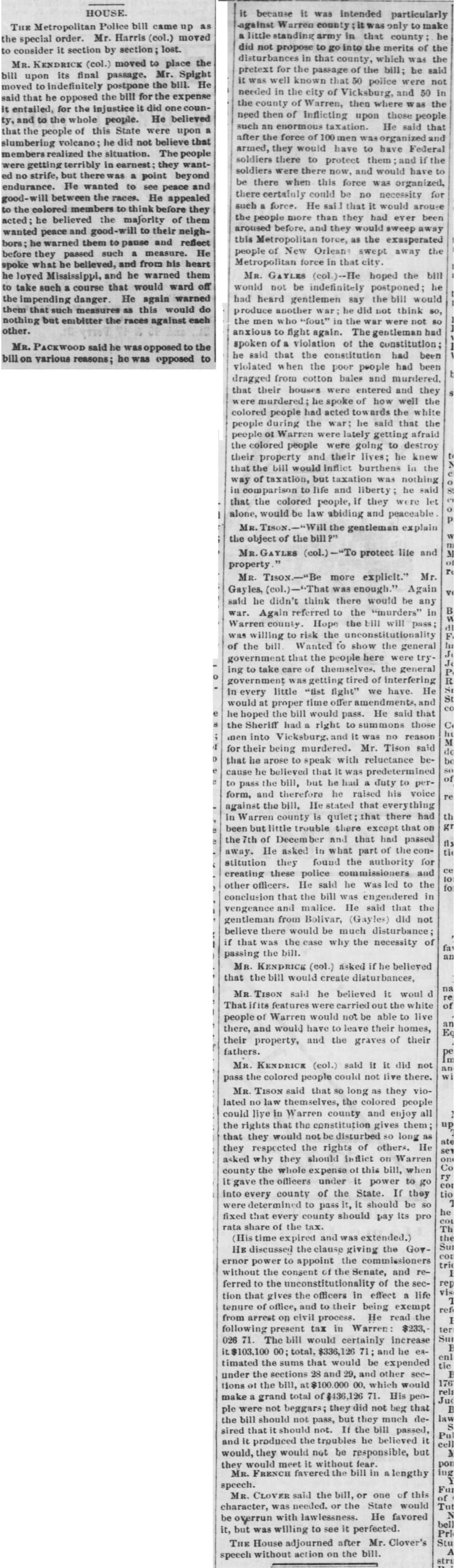
The Metropolitan Police bill [a response to the Vicksburg Massacre a couple of months before] came up as the special order. Mr. Harris (col.) moved to consider it section by section; lost.
MR. KENDRICK (col.) moved to place the bill upon its final passage. Mr. Spight moved to indefinitely postpone the bill. He said that he opposed the bill for the expense it entailed, for the injustice it did one county, and to the whole people. He believed that the people of this State were upon a slumbering volcano; he did not believe that members realized the situation. The people were getting terribly in earnest; they wanted no strife, but there was a point beyond endurance. He wanted to see peace and good-will between the races. He appealed to the colored members to think before they acted; he believed the majority of them wanted peace and good-will to their neighbors; he warned them to pause and reflect before they passed such a measure. He spoke what he believed, and from his heart he loved Mississippi, and he warned them to take such a course that would ward off the impending danger. He again warned them that such measures as this would do nothing but embitter the races against each other.
MR. PACKWOOD said he was opposed to the bill on various reasons; he was opposed to it because it was intended particularly against Warren county; it was only to make a little standing army in that county; he did not propose to go into the merits of the disturbances in that county, which was the pretext for the passage of the bill; he said it was well known that 50 police were not needed in the city of Vicksburg, and 50 in the county of Warren, then where was the need then of inflicting upon those people such an enormous taxation. He said that after the force of 100 men was organized and armed, they would have to have Federal soldiers there to protect them; and if the soldiers were there now, and would have to be there when this force was organized, there certainly could be no necessity for such a force. He said that it would arouse the people more than they had ever been aroused before, and they would sweep away this Metropolitan force, as the exasperated people of New Orleans swept away the Metropolitan force in that city.
MR. GAYLES (col.) – He hoped the bill would not be indefinitely postponed; he had heard gentlemen say the bill would produce another war; he did not think so, the men who “fout” in the war were not so anxious to fight again. The gentleman had spoken of a violation of the constitution; he said that the constitution had been violated when the poor people had been dragged from cotton bales and murdered, that their houses were entered and they were murdered; he spoke of how well the colored people had acted towards the white people during the war; he said that the people of Warren were lately getting afraid the colored people were going to destroy their property and their lives; he knew that the bill would inflict burthens in the way of taxation, but taxation was nothing in comparison to life and liberty; he said that the colored people, if they were let alone, would be law abiding and peaceable.
MR. TISON. – “Will the gentleman explain the object of the bill?”
MR. GAYLES (col.) – “To protect life and property.”
MR. TISON. – “Be more explicit.” Mr. Gayles, (col.) – “That was enough.” Again said he didn’t think there would be any war. Again referred to the “murders” in Warren county. Hope the bill will pass; was willing to risk the unconstitutionality of the bill. Wanted to show the general government that the people here were trying to take care of themselves, the general government was getting tired of interfering in every little “fist fight” we have. He would at proper time offer amendments, and he hoped the bill would pass. He said that the Sheriff [Peter Crosby] had a right to summons those men into Vicksburg, and it was no reason for their being murdered. Mr. Tison said that he arose to speak with reluctance because he believed that it was predetermined to pass the bill, but he had a duty to perform, and therefore he raised his voice against the bill. He stated that everything in Warren county is quiet; that there had been but little trouble there except that on the 7th of December and that had passed away. He asked in what part of the constitution they found the authority for creating these police commissioners and other officers. He said he was led to the conclusion that the bill was engendered in vengeance and malice. He said that the gentleman from Bolivar, (Gayles) did not believe there would be much disturbance; if that was the case why the necessity of passing the bill.
MR. KENDRICK (col.) asked if he believed that the bill would create disturbances.
MR. TISON said he believed it would. That if its features were carried out the white people of Warren would not be able to live there, and would have to leave their homes, their property, and the graves of their fathers.
MR. KENDRICK (col.) said if it did not pass the colored people could not live there.
MR. TISON said that so long as they violated no law themselves, the colored people could live in Warren county and enjoy all the rights that the constitution gives them; that they would not be disturbed so long as they respected the rights of others. He asked why they should inflict on Warren county the whole expense of this bill, when it gave the officers under it power to go into every county of the State. If they were determined to pass it, it should be so fixed that every county should pay its pro rata share of the tax.
(His time expired and was extended.)
He discussed the clause giving the Governor power to appoint the commissioners without the consent of the Senate, and referred to the unconstitutionality of the section that gives the officers in effect a life tenure of office, and to their being exempt from arrest on civil process. He read the following present tax in Warren: $233,026.71. The bill would certainly increase it $103,100.00; total, $336,126.71; and he estimated the sums that would be expended under the sections 28 and 29, and other sections of the bill, at $100,000.00, which would make a grand total of $436,126.71. His people were not beggars; they did not beg that the bill should not pass, but they much desired that it should not. If the bill passed, and it produced the troubles he believed it would, they would not be responsible, but they would meet it without fear.
MR. FRENCH favored the bill in a lengthy speech.
MR. CLOVER said the bill, or one of this character, was needed, or the State would be overrun with lawlessness. He favored it, but was willing to see it perfected.
The House adjourned after Mr. Clover’s speech without action on the bill.